

A power outage in a healthcare facility can lead to failure of life-support systems, putting lives at immediate risk. Keeping hospitals powered up during outages is, therefore, a nonnegotiable requirement.
Beyond the risk to patients, a power failure introduces severe operational challenges, including data loss, steep compliance penalties, financial losses and a negative impact on your facility’s reputation.
Understanding Hospital Backup Power Requirements
Navigating the regulatory landscape is one of the most challenging aspects of facility management. Two central bodies set and enforce the standards for emergency power in healthcare institutions — the National Fire Protection Association (NFPA) and the Joint Commission (TJC).
NFPA 110 and NFPA 99
The primary authority governing emergency power is the NFPA. Specifically, NFPA 110: Standard for Emergency and Standby Power Systems dictates the performance requirements for your power backup equipment. One of the most critical rules in this standard is the transfer time requirement. For life safety and critical systems, facilities must restore electricity within 10 seconds of an outage.
While NFPA 110 focuses on hardware performance, NFPA 99: Health Care Facilities Code uses a risk-based approach to define how various systems impact patient safety. It is the standard that helps you categorize building systems based on the level of risk to patients if those systems were to fail.
TJC
TJC enforces NFPA’s standards as part of its accreditation process for healthcare facilities. TJC’s accreditation is critical for hospital operations and funding, meaning your facility’s financial health is tied directly to your power reliability. Inspectors will verify that your emergency power system is present, regularly tested and maintained according to NFPA standards.
How to Define Your Facility’s Essential Loads
During a power outage, the goal is to direct backup power to the most essential systems. Trying to power the entire facility can lead to oversized, prohibitively expensive systems. To manage this, NFPA 99 requires you to segregate your electrical loads into three distinct branches:
- Life safety: This is the highest priority branch, as it includes systems essential for the safety of patients and everyone in the building. These systems include all egress lighting for hallways and exits, fire alarm systems, emergency communications and the accessories needed to keep the generator running.
- Critical: The critical branch serves areas and functions directly related to patient care. These are systems where a loss of power would have an immediate impact on patient health, including power for operating rooms, delivery rooms, ICUs and coronary care units.
- Equipment: The equipment branch supports the core mechanical systems required for the facility to operate effectively during an extended outage. These include specific HVAC systems needed to maintain sterile environments, as well as medical air compressors, vacuum systems and essential data servers.
Planning Your Critical Load Priorities
Identifying your hospital’s power needs during an emergency requires a thorough audit:
- Form a committee: Build a committee of key stakeholders, including your facility manager, clinical directors, IT leadership and electrical engineers.
- Conduct a room-by-room audit: Identify every piece of equipment in the facility.
- Categorize each item: Assign every load to one of the three branches mentioned above or mark it as “nonessential.”
- Calculate total demand: Work with an electrical engineer to sum the wattage for all essential items to determine your base load requirement.
The Core Components of a Compliant Power System
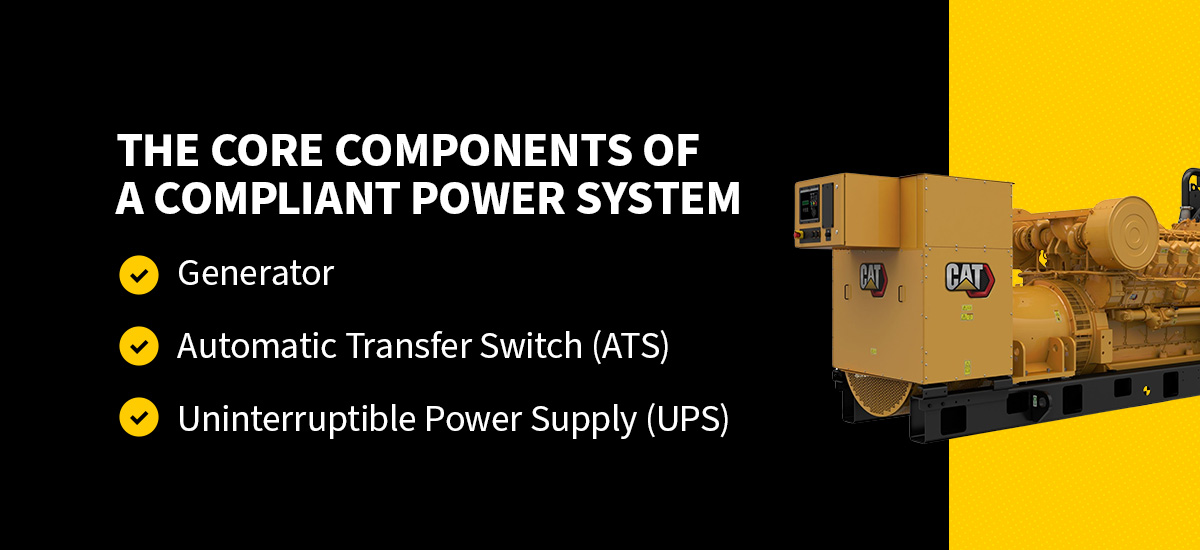
To meet rigorous NFPA and TJC standards, your facility requires a power system comprising three integrated technologies.
Generador
The generator is the primary source of long-term backup power when the utility grid fails. In the healthcare sector, diesel generators remain the industry standard due to their durability, ability to power heavy electrical loads quickly and the stability of on-site fuel storage. The unit must be capable of carrying all essential loads for up to 96 hours.
Automatic Transfer Switch (ATS)
The ATS monitors the utility power 24/7. When it detects a power loss or a significant voltage drop, it automatically signals the generator to start. Once the generator is running at the correct speed and voltage, the ATS switches the facility’s load from the utility to the generator.
Uninterruptible Power Supply (UPS)
A UPS serves as a bridge power source. It uses batteries to provide instant electricity the moment utility power is lost, filling the gap before the generator kicks in. These power solutions are essential for devices that cannot tolerate even a momentary flicker, like network servers, data centers and sensitive diagnostic machines.
Selecting the Right Healthcare Facility Generator and Components
Once you understand your loads, you can move to hardware selection. Choosing the right equipment requires matching technical capabilities to your specific operational risks.
Consider these factors when reviewing your healthcare facility generator specifications:
- Sizing: Your generator must be able to handle your total critical load, plus a safety margin for future growth. Undersizing risks system failure when you need it most, while massive oversizing can lead to wet stacking.
- Fuel type: Diesel is the preferred fuel type for healthcare facilities since it can be stored on-site in large quantities, providing total autonomy.
- Runtime: Again, facilities must plan to sustain operations for a minimum of 96 hours. You can achieve this by storing enough fuel on-site.
A Practical Guide to Testing and Maintenance
Keeping hospitals powered up requires a culture of proactive maintenance and rigorous testing.
Planning for Redundancy and Fuel Security
Reliance on a single point of failure is risky. Many facilities adopt an N+1 redundancy strategy. This strategy means if you need three generators to run your facility, you install four. If one fails or is down for maintenance, you still have full capacity.
Fuel security is equally vital. You should have a priority fuel delivery contract in place with a vendor who guarantees service during emergencies.
Routine Testing
NFPA and TJC are very specific about testing schedules. You must run your generator at least once a month for a minimum of 30 minutes under a dynamic load, typically at least 30% of the generator’s nameplate rating.
NFPA 110 mandates that life-critical systems undergo an extended run load test at least once every 36 months. This test must last for at least four hours while the system operates under its actual building load or 30% of its nameplate rating.
Key Maintenance Tasks
A proactive maintenance agreement with a qualified service provider is crucial to maintaining system compliance. Your maintenance log should track these essential tasks:
- Fuel quality checks
- Battery inspection
- Coolant level and heater checks
- Oil and filter changes
- Cleaning around the generator
Get Ready for a Power Outage With Thompson Machinery
Building a resilient healthcare power strategy depends on strict compliance with industry standards, proper equipment selection and diligent maintenance. When these components are aligned, you create a system that protects your patients, your data, your reputation and your bottom line. Executing this strategy correctly requires deep technical expertise in power systems. A partner with proven healthcare experience ensures your plan is sound and that the installation and maintenance are performed flawlessly.
Thompson Machinery is a dedicated partner to the healthcare industry, specializing in providing and servicing Cat® power solutions. Our team understands the unique pressures of the healthcare environment and helps you move from planning to implementation. Contact a Power Systems expert from Thompson Machinery today to assess your facility’s needs and build a reliable, compliant backup power solution.