

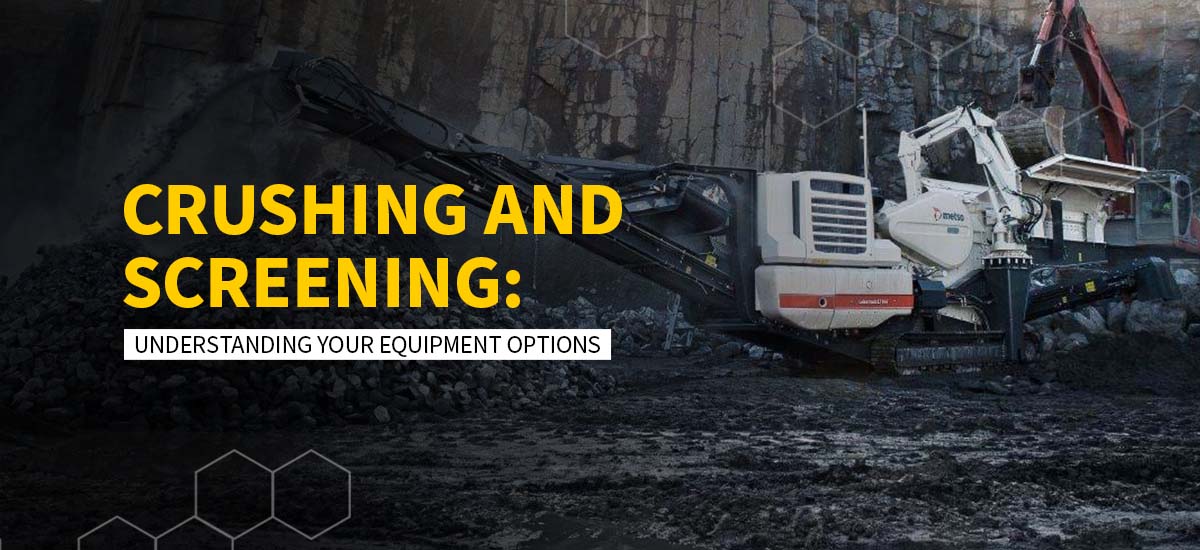
The right crushing and screening setup can deliver measurable results. You can improve throughput, lower cost per ton, have predictable wear intervals and maintain on-schedule production. Get there by understanding your crushing and screening equipment options and how the pieces work together in a complete circuit.
This guide explains crushing and screening equipment types, how they function in a processing system and the factors that determine which setup fits your material, application and production goals.
The Main Types of Crushing Equipment
Crushers reduce raw material to smaller sizes through compression or impact. Different crusher types are engineered for different stages of a processing circuit and different material characteristics.
Jaw Crushers
Jaw crushers are the standard primary crusher in most processing circuits. Raw material enters at the top and encounters two jaw plates in a V-shaped crushing chamber. One plate is fixed, while the other moves in a swinging motion. Together, they apply compressive force to fracture large rocks into manageable pieces.
Jaw crushers handle hard, abrasive materials like granite, basalt and trap rock. They process large, irregular feed and reduce it to a size the secondary crusher can handle.
Cone Crushers
Cone crushers are deployed as secondary and tertiary crushers after the jaw crusher reduces material in the primary stage. A rotating mantle gyrates inside a stationary concave liner, squeezing material into smaller, more uniform pieces. This continuous crushing action delivers high throughput and consistent gradation.
This type of crusher is ideal for producing spec aggregate, road base or concrete stone where gradation tolerance is tight.
Impact Crushers
Impact crushers work differently from compression crushers. Instead of squeezing material, they use high-speed impact force to break it. A spinning rotor with heavy metal bars strikes material at speed, fracturing it and producing a highly cubical, precisely shaped end product.
These crushers are effective for softer materials like limestone and for recycling applications where you’re processing crushed concrete or asphalt millings.
There are two main types of impact crushers. Horizontal shaft impactors handle primary and secondary reduction for softer materials. Vertical shaft impactors produce fine shaping and manufactured sand.
The Main Types of Screening Equipment
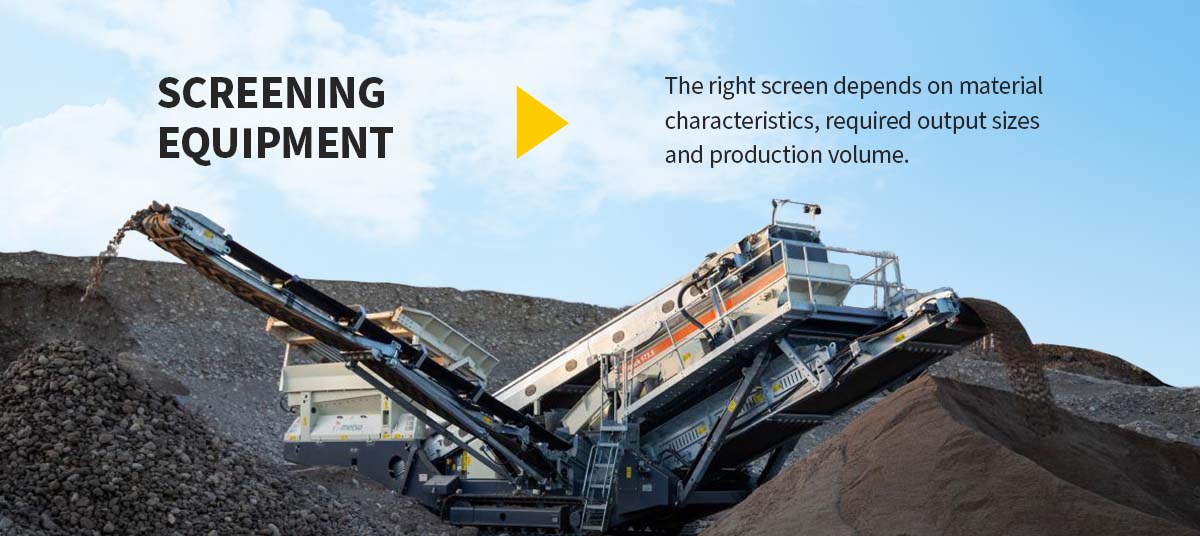
Screening equipment separates crushed material by particle size to produce spec-grade product at each stage of the circuit. The right screen depends on material characteristics, required output sizes and production volume.
Vibrating Screens
Vibrating screens use vibration to cause material to stratify. Finer particles migrate toward the screen surface and fall through. Larger particles ride to the end for discharge. The motion can be linear, circular or elliptical, depending on the application.
Types of vibrating screens include:
- Incline screens: These screens deliver high throughput and work best for dry or free-flowing material.
- Horizontal screens: Choose horizontal screens for wet, sticky or fine material that needs more contact time with the screen surface.
- Multi-deck screens: Multi-deck screens can produce multiple product sizes in a single pass.
Scalpers
Scalping screens are preprocessing and protection tools. They remove oversized rock, fines, clay, topsoil or overburden before material enters the primary crusher. Scalpers typically run as the first machine in a processing sequence. By stripping unwanted material up front, scalpers protect downstream equipment from unnecessary wear and reduce load on the primary crusher.
Scalpers also serve as stand-alone units for topsoil separation, compost, and construction and demolition recycling.
Trommels
Trommels also handle wet, sticky, organic or clay-heavy material. A trommel is a rotating cylindrical drum with perforated panels.
The rotating action and internal lifter bars break up clumps and expose material to the screen surface. Trommels are widely used in topsoil processing, composting, recycling and aggregate prescreening. Scroll or rifled drums are gentler and suited for lighter recyclables.
How Crushers and Screens Work Together
Material moves through a staged sequence of size reduction and separation in a crushing and screening circuit.
Each stage progressively refines the product:
- Primary crushing handles large raw feed
- Secondary crushing reduces it further and refines the gradation
- Tertiary crushing targets final spec sizing and product shape
An aggregate circuit typically follows this process. Material enters a scalper prescreen, then goes to a jaw crusher for primary reduction, then to a cone or impact crusher for secondary reduction, then to a vibrating screen. Material that meets spec goes to the stockpile. Oversized material returns to the crusher in a closed circuit.
Two circuit types are used in aggregate operations. In an open circuit, material passes through each crusher once and moves forward with a simpler layout and lower capital cost, but less control over final gradation. In a closed circuit, oversize material screened after the crusher is returned via conveyor for recrushing. This requires more equipment but delivers tighter product control and higher efficiency.
Mobile Crushing and Screening Plant Overview
A mobile crushing and screening plant is an integrated, deployable system where track-mounted units combine into a full processing circuit that moves with the work. Instead of hauling raw material to a fixed plant, mobile plants bring the crusher to the material. Eliminating multistage hauling reduces fuel costs, labor and truck wear. This can lower the cost per ton and improve site efficiency.
Mobile plants work well for quarry face crushing, road construction, concrete and asphalt recycling, site development and demolition work. When you’re working at multiple sites or your material source changes as the project progresses, mobile plants offer the flexibility you need, with faster setup times that keep pace with your project.
Key Factors for Choosing the Right Setup
Four variables determine which equipment combination will perform and protect your return on investment.
- Material type and hardness: Different crushing methods for aggregates depend on material characteristics and abrasion index. For example, hard, abrasive rock like granite and basalt demands jaw and cone crushers. Softer stone, like limestone, suits impact crushers.
- Required output specs: Target product size and gradation determine screen configuration, mesh size and whether you need a secondary or tertiary stage. Tighter specs call for closed-circuit configurations. If you need consistent gradation within a narrow tolerance, your circuit design must provide that control.
- Production volume: Tons per hour targets determine equipment size and class. Undersizing creates a bottleneck. Multistage circuits are needed to hit higher volumes efficiently. Match your equipment capacity to your throughput goals to maximize production.
- Mobility requirements: Contractors working multiple sites may benefit from track-mounted mobile plants, whereas fixed quarry operations may benefit from semi-mobile or stationary setups. The right mobility level depends on whether your material source moves or stays in one location.
Get Started With Thompson Machinery
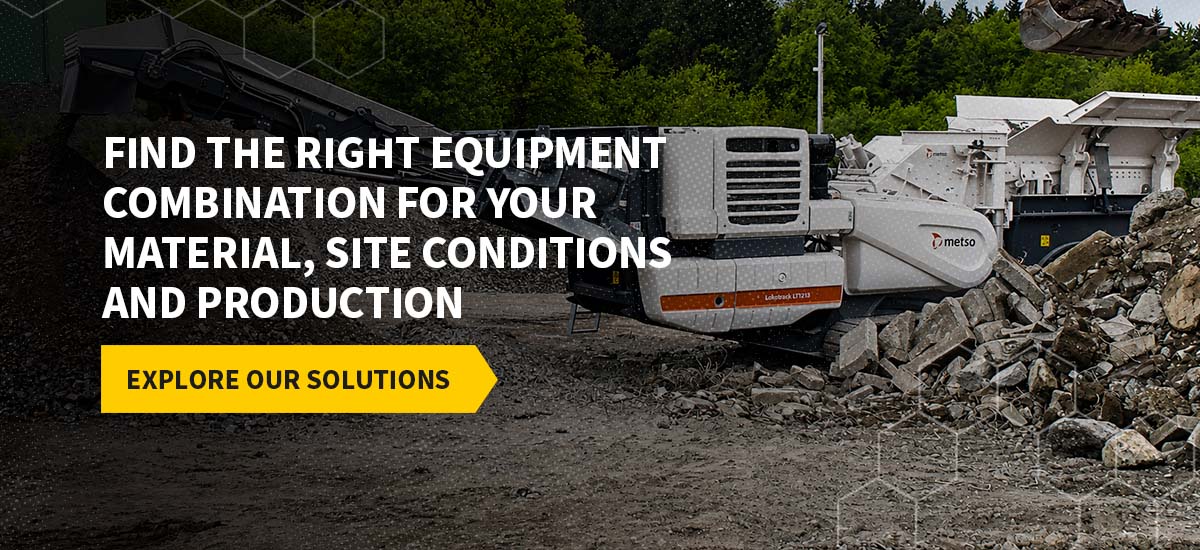
Finding the right equipment combination for your material, site conditions and production targets is where Thompson Machinery comes in. Since 1944, we’ve served contractors and operators across Middle Tennessee, West Tennessee and North Mississippi with equipment, parts and service support that keeps operations running.
Our Metso crushing and screening lineup delivers the performance and durability that aggregate operations demand. We offer flexible acquisition options, including sale, lease and rent-to-own, backed by parts support, service, maintenance and operator training resources that get your team running at full capability. Explore our crushing and screening solutions to find the right fit for your operation.