


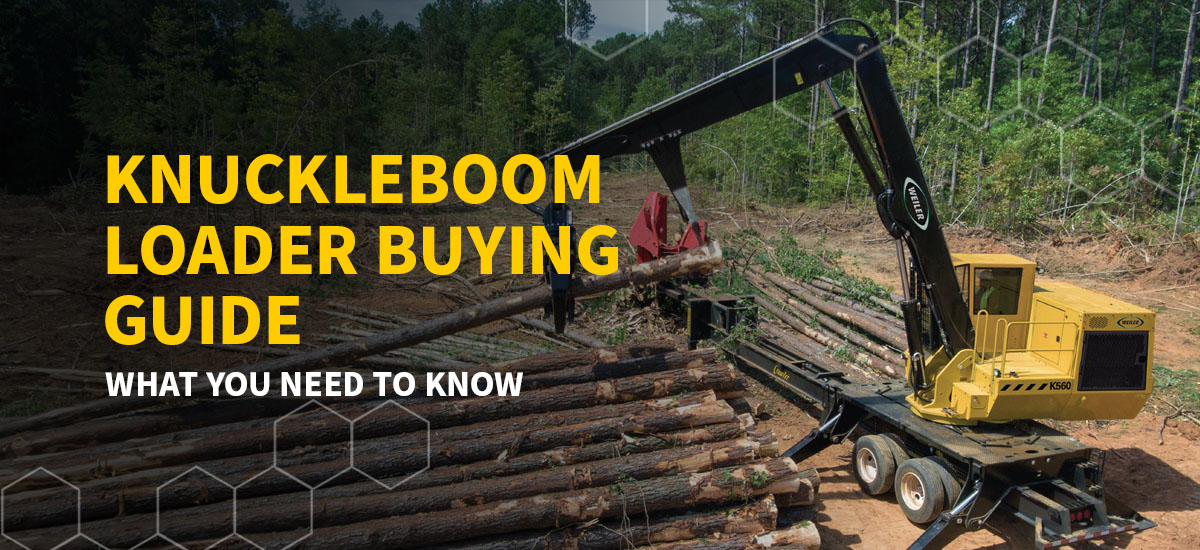
The right knuckleboom loader can optimize your logging operation — more wood moved per shift, lower cost per ton and a machine that holds up season after season, which saves you time, money and patience.
Choosing a knuckleboom loader requires understanding some critical specs and how they connect to your everyday work. Learn what to look for in a knuckleboom loader so you can make a confident, well-informed decision.
How to Evaluate Knuckleboom Loaders
Every loader on the market shares the same basic anatomy — boom, grapple, hydraulic system and mounting platform — but the differences in how those components are configured determine whether a machine thrives or struggles on your jobsite. Consider these four key factors when evaluating your options.
1. Match the Machine and Grapple to Your Application
Your primary application drives every other decision. A loader built for stacking full-length sawtimber has different demands than one handling pulpwood on a thinning operation. So, start with the work itself and build outward.
Grapple selection ties directly to the material you handle most. Common grapple types include:
- Log grapples with a heel: These grapples provide a solid base for lifting and stacking full-length timber. The heel cradles the load while curved tines lock it in place.
- Pulpwood grapples: Tighter tine spacing grips smaller-diameter wood without losing pieces. These grapples are designed for handling pulpwood efficiently.
- Bunching grapples: Several small stems can be grabbed at once, which speeds up thinning jobs considerably. Experienced operators rely on these grapples to increase cycle times on high-volume operations.
The right pairing between grapple and application affects your cycle times and the amount of wood you move per hour. Keep in mind that your work environment matters just as much as your material. Tight landings call for compact models with strong swing torque, while open log yards give you room to run a larger machine with extended reach.
2. Understand Lift Capacity and Load Charts
Lift capacity changes based on how far the boom is extended and the angle of the lift. A machine might handle a heavy load close in, but that capacity drops at full reach. Considering knuckleboom loader lift capacity is essential before you commit.
Load charts map out the rated capacity at every boom position and angle, and they’re one of the most valuable tools in your decision-making process. Before you sit down with a spec sheet, take stock of your typical lifting scenarios:
- The heights to which you stack
- The distances you reach across
- The weights you handle
Then, compare those real-world demands against the load chart. If your daily work puts you near the machine’s limits, size up — your crew and your productivity will benefit.
3. Consider Boom Reach and Hydraulics
Boom length determines your working range, but there’s always a trade-off. A longer boom extends your reach for loading onto flatbeds or stacking at height, while a shorter boom delivers more lift capacity at the same extension point.
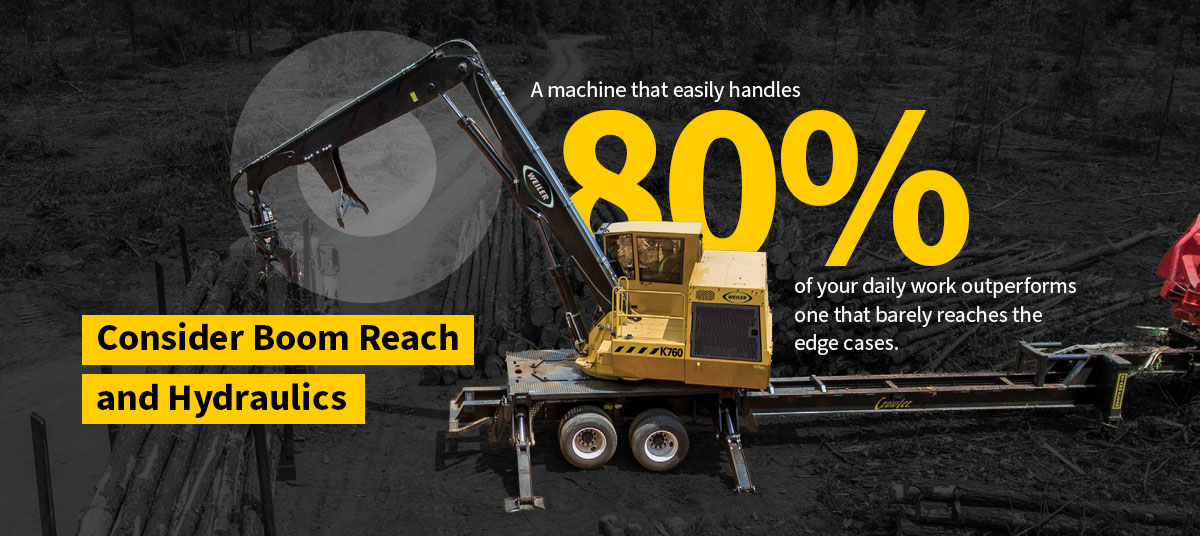
Some models accept boom extensions for added flexibility, but the best approach is to optimize for your most common tasks. A machine that easily handles 80% of your daily work outperforms one that barely reaches the edge cases.
The hydraulic system is equally important when comparing knuckleboom loader specs. Hydraulic flow rate and system pressure tell you how quickly the machine responds and how much force it delivers — both directly translate into cycle times. Smooth, responsive hydraulics also let you operate multiple functions at once, like lifting, swinging and grappling simultaneously, which experienced operators rely on to keep production moving.
When reviewing spec sheets, pay close attention to these numbers alongside the lift charts.
4. Determine Mounting Configurations
Knuckleboom loaders come in several mounting configurations, and the right one depends on how and where you work:
- Trailer-mounted units: These are the most common in forestry operations. They offer portability between landings, pair with a delimber-slasher package for a complete merchandising system and provide a stable working platform once positioned on level ground.
- Stationary-mount loaders: These serve mill yard applications where the machine stays in one location. They’re optimized for consistent, high-volume loading operations.
- Track-mounted models: For in-woods landing operations, these work well on soft or uneven terrain. Availability varies by manufacturer, though these configurations are less common than trailer-mounted units.
Weiler knuckleboom loaders — purpose-built forestry machines that evolved from the Cat® forestry line — are available in trailer-mount configurations with optional delimber-slasher packages.
Which Ownership Option Fits Your Operation?
Your acquisition strategy should reflect your budget, how often you’ll use the machine and your long-term fleet goals:
- New equipment: Inventories include the latest hydraulic technology, peak fuel efficiency, full factory warranty coverage and zero unknown hours on the meter. Every hour is yours, and every maintenance record starts clean. Reputable dealers offer new Weiler knuckleboom loaders backed by comprehensive support.
- Used equipment: You get proven performance at a lower initial investment. Quality used knuckleboom loaders from trusted dealers undergo thorough evaluations before they reach the lot. The machine has been inspected and serviced to a high standard.
- Rental options: Rentals offer flexibility without a long-term commitment. This option makes sense for seasonal operations that only need a loader for part of the year, one-time projects or when you want to evaluate a machine’s performance in your work environment before purchasing.
Understand Your Total Cost of Ownership
The purchase price is just the starting point. When calculating the total cost of ownership (TCO), you’ll include every dollar you spend over the machine’s working life, and this number determines whether your investment pays off.
On the financing side, Cat Financial offers programs that spread costs over time, so you can put equipment to work immediately while preserving cash for operational expenses. Flexible financing terms help you align payments with your revenue cycle.
Beyond the up-front price, plan for ongoing expenses. Diesel fuel is likely your largest recurring cost, though fuel-efficient engines reduce consumption per operating hour. Other ongoing costs include:
- Hydraulic fluid, engine oil and filters.
- Diesel exhaust fluid (DEF).
- Operator labor, although a more productive machine lets one operator move more material per shift.
Quality equipment from a reputable manufacturer holds its resale value, too. A machine with documented maintenance history through a certified dealer commands a higher price when it’s time to sell or trade. This lowers your true cost of ownership over the long run.
How Parts Availability and Dealer Support Keep You Running
Uptime is everything. When a loader goes down in the middle of a cut, every hour it sits idle is wood that doesn’t get loaded and trucks that don’t get filled.
A dealer with an extensive parts inventory and knowledgeable technicians can get you back to work quickly. Scheduled maintenance through a qualified service department — fluid changes, filter replacements and system inspections — catches small issues before they turn into expensive failures and unplanned downtime.
This dependable service keeps your operation moving, which is largely why a strong dealer partnership matters as much as the machine itself.
Find Your Next Knuckleboom Loader With Thompson Machinery
Evaluating knuckleboom loaders involves balancing specs, application and long-term value — and you don’t have to figure it all out alone. Thompson Machinery has been the trusted Cat dealer in Middle Tennessee, West Tennessee and North Mississippi since 1944. We offer a full range of new and used knuckleboom loaders, rental options, and the parts and service support to keep your equipment productive for years to come.
Contact us today to discuss your operation and find the right loader for your needs.