

Unexpected machine downtime and underperformance cost you time and money. A condition monitoring program gives your team the key data they need to identify performance issues before they cause downtime. Learn how you can use condition monitoring to maximize your fleet’s performance and efficiency.
What Is Equipment Condition Monitoring?
Equipment condition monitoring (CM) is a proactive maintenance strategy. Instead of reacting to failures or performing scheduled maintenance on healthy machines, it uses real-time data to track the actual health of your fleet.
CM tracks parameters such as vibration, temperature and pressure to detect deviations from normal operation. If the data deviates from the baseline, it sends an automated alert to the maintenance manager or analyst. A message, email or dashboard notification tells you which machine has an issue, what needs attention and its severity. Technicians analyze the data and can begin diagnosing the root cause. They can generate a work order, proactively schedule the repair and order any necessary parts at the best price.
What Are the Benefits of Condition Monitoring for Equipment?
Integrating condition monitoring into your fleet has many benefits for your productivity, bottom line and your workers’ safety.
Maximize Uptime and Productivity
Condition monitoring enables you to predict equipment failures before they happen. This minimizes downtime and logistics headaches caused by a machine going down during the peak hours of the workday.
You can also schedule any necessary maintenance during planned downtime, keeping your revenue-generating equipment operational when it’s needed most. Planning maintenance also gives you more time to source rentals to fill the gap in your fleet.
Reduce Long-Term Repair Costs and Prevent Failures
Fixing a small, identified issue is far less expensive than reacting to an equipment breakdown. This is because you solve the issue before it develops, protecting components.
Condition monitoring also enables you to time routine maintenance tasks more precisely. Scheduling services and parts as needed minimizes waste, extends part life and reduces repair costs.
Extend the Operational Lifespan of Your Machines
A proactive strategy for addressing wear and tear prevents cumulative damage, allowing equipment to run more efficiently for longer and maximizing your return on investment.
All heavy equipment parts must work together efficiently. Ensuring each component performs within the ideal parameters helps minimize mechanical stress and maximize performance. Each part affects the others. CM allows the technician to fine-tune each part’s adjustments to preserve the health of the whole machine, increasing equipment longevity.
Enhance Overall Fleet and Operator Safety
Safety is paramount on the jobsite. Under OSHA’s General Duty Clause, you must provide a workplace free from recognized hazards. Using CM can help you mitigate the risks of unexpected equipment failures that can pose safety hazards to operators and other personnel on-site. Identifying issues like compromised hydraulic lines or failing brakes before a breakdown helps maintain a safer jobsite.
Condition Monitoring Methods and Technologies
Condition monitoring deploys sensors to detect the health of various components. Here’s how they work in more detail.
Vibration Analysis for Heavy Equipment
Specialized sensors or accelerometers measure vibrations in your heavy equipment. You typically deploy these sensors in machines with rotating parts like engines, pumps and gearboxes. Each of these components has a unique vibration signature when it is healthy. Changes in the vibration signature are often the earliest indicator of a mechanical fault.
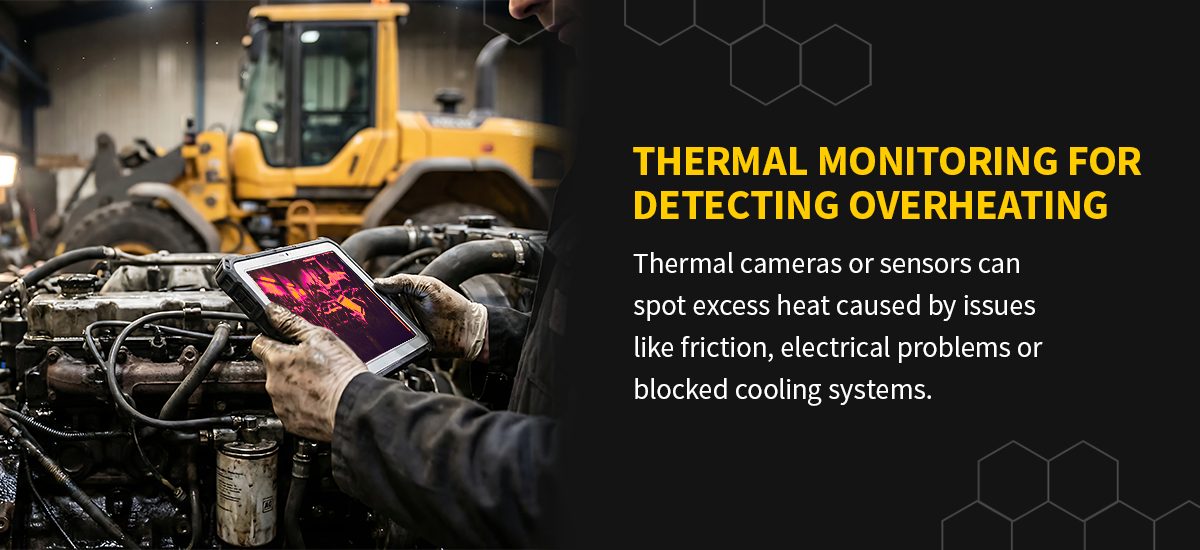
Thermal Monitoring for Detecting Overheating
Thermal cameras or sensors can spot excess heat caused by issues like friction, electrical problems or blocked cooling systems. Thermal monitoring uses infrared cameras and sensors to find hot spots. Properly maintaining machines during the hot summer months helps minimize overheating and breakdowns.
Fluid Analysis for Internal Health Insights
The oil, fuel and coolant in your equipment give your technician vital insights into the machine’s internal condition. A technician collects small fluid samples and sends them to a lab for testing. Under a microscope, labs can reveal microscopic wear particles, chemical breakdown and other signs of degradation that may be invisible to the naked eye.
Acoustic Analysis for Identifying Irregular Sounds
Specialized microphones can detect high-frequency sounds to find faults. These can include air or fluid leaks, electrical arcing or the early stages of component wear. Acoustic analysis starts long before you hear your engine struggling to turn over. It can even find issues before they produce significant vibrations or thermal signatures.
How to Interpret Condition Monitoring Data
The data you collect through CM is only the first step. The real value lies in identifying patterns in the data to diagnose and resolve mechanical faults.
Diagnosing Imbalance and Misalignment With Vibration Data
Imbalance and misalignment are common in rotating parts. In vibration data, a strong symmetrical peak at the machine’s primary rotational speed can indicate imbalance. Misalignment appears as a series of peaks at multiples of the running speed.
Identifying Early-Stage Bearing Faults
Bearings can provide warnings in vibration data long before they fail. A faulty bearing usually appears as a series of small, sharp spikes or impulses at specific frequencies. These frequencies correspond to the geometry of the bearing, enabling a trained analyst to confirm the issue confidently without having to take apart components or perform physical tests.
Detecting Mechanical Looseness and Wear
Loose mechanical parts are a common issue that creates a distinct vibration signature. They appear as a series of nonsynchronous peaks, so they do not line up neatly with the machine’s primary running speed. The pattern suggests a loose part that needs inspection and tightening.
Best Practices for Equipment Condition Monitoring
Follow these best practices for an effective condition monitoring program:
- Prioritize critical equipment: Identify the machines most critical to your operations and those that drive the greatest impact for your business.
- Establish performance baselines: Measure your machines when they are healthy to create a normal baseline. Base all future alerts and diagnoses on deviations from this baseline.
- Choose the right monitoring techniques: The right method depends on the machine and its likely failure modes. For a motor, this might be vibration. An electrical panel likely needs a thermal sensor.
- Integrate data with maintenance workflows: You need to act quickly on alerts, so make them actionable. Tie your monitoring system to your maintenance team’s process for creating work orders and scheduling repairs.
- Supplement teams with training and expertise: Check if your team has the right expertise. A skilled technician or analyst can help you interpret the data, manage the system and make the final maintenance decisions if necessary.
Partner With Thompson Machinery for Expert Condition Monitoring
An effective condition monitoring program helps you move from reactive to proactive maintenance. Looking after your machines maximizes your uptime, even during peak season, so you tackle one tough project after the next. You need the right expertise to interpret the data, diagnose and solve the fault.
At Thompson Machinery, we deliver condition monitoring services powered by Cat® Product Link™ technology from on-site assessments to S.O.S℠ Fluid Analysis. Our local technicians complete more than 45 hours of product and safety training annually to best serve our partners across Middle Tennessee, West Tennessee and North Mississippi.
As your exclusive Cat dealer in the region, we’re committed to keeping your equipment performing when it matters most. Call us at 800-228-3644 or contact us online to learn more.