


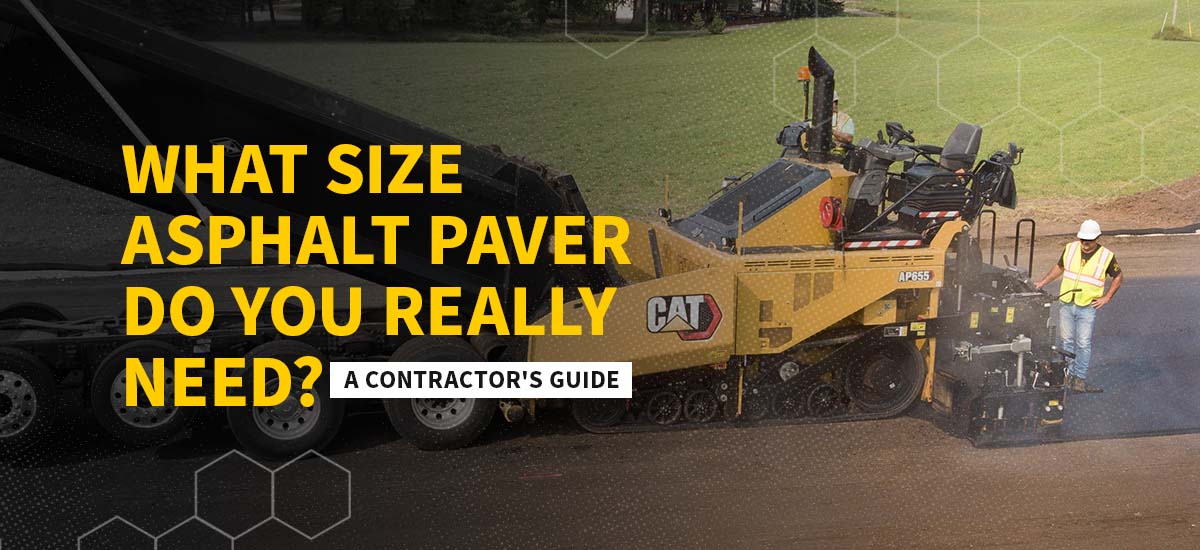
Your choice of asphalt paver directly affects your profitability. Buy too small and you lose higher‑value work. Too large, and you pay for capacity you don’t need.
With the asphalt paver market projected to exceed $3.7 billion by 2032, competition is rising alongside infrastructure demand and advancing technology. Contractors need equipment that delivers efficiency without draining resources.
This guide gives you a framework for evaluating project requirements — from material volume to production rates — so you can select a paver that supports your current workloads and long‑term growth.
Why Profitability Starts With the Right-Sized Paver
Your asphalt paver’s efficiency affects every aspect of your operation, including labor costs, fuel consumption, material waste, and your ability to compete for premium projects.
Mismatched pavers carry genuine financial consequences. Equipment that only accommodates small jobs will cost less up front, but will put larger projects out of your reach. In contrast, buying a larger machine than you need means paying for unused capacity over time. You need equipment that’s capable of handling your current workload and scaling as your business grows.
A properly sized paver improves labor efficiency by aligning crew size and capacity. It also reduces material waste through precision features like automatic grade and slope controls. These factors translate directly to profit margins for road construction projects.
Pre-Purchase Considerations
The less maintenance your paver requires over time, the faster it will recoup its initial cost and continue producing income. Before analyzing the specifications, consider how these variables influence your total cost of ownership.
- Machine size: Paving width and capacity should suit your typical project scope. Compact pavers excel in tight spaces, while highway-class machines deliver high-volume production.
- Performance and mat quality: Automatic grade controls support consistent results, reducing rework and downtime.
- Pavement quality: Construction quality directly impacts long-term pavement performance. The same principle applies to your equipment — durable components extend machine lifespan and protect your investment.
- Mobility requirements: Track pavers provide stability on uneven terrain, while wheel pavers offer maneuverability for urban projects and frequent relocation.
How to Choose an Asphalt Paver
Selecting the right asphalt paver becomes easier when considering your project needs. This three-step framework helps you analyze your business, convert needs into specifications, and evaluate long-term value.
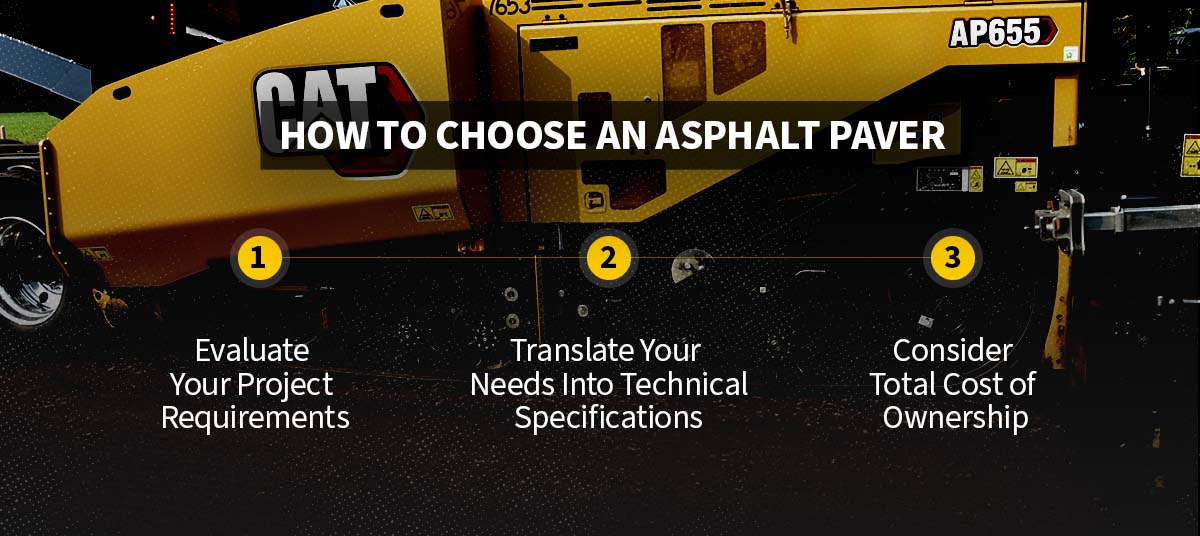
1. Evaluate Your Project Requirements
Start by analyzing your project pipeline. Identify the percentage of work that falls into residential, commercial, and highway categories. This breakdown highlights asphalt paver capacity requirements.
- Job size and configuration: Driveways and parking lots call for compact, maneuverable machines. Extensive highway projects demand high-capacity pavers with wide screed ranges.
- Paving width: What widths do you typically encounter? If most of your work involves 10- to 12-foot widths, look for machines with screeds in that range.
- Material capacity: Undersized hoppers create bottlenecks that slow production. Your hopper capacity and conveyor speed should complement your material volume.
- Support fleet compatibility: Check that your existing rollers can keep pace with the paver’s production rate.
Along with your current needs, think about the type of work you want to handle in three to five years. Consult the National Asphalt Pavement Association’s resources to understand design standards and industry shifts.
2. Translate Your Needs Into Technical Specifications
Once you understand your project requirements, convert them into specific features to determine paver width and thickness capabilities.
- Power and speed: Higher horsepower handles heavy-duty jobs and maintains consistent load speed. Match the engine capacity to your typical tonnage.
- Screed type: Variable-width screeds offer flexibility across project types. Choose front- or rear-mounted extenders based on your material flow preferences.
- Material delivery: Variable-speed conveyors with automatic tensioning support consistent mix distribution.
- Automation: User-friendly controls minimize operator error and improve mat quality. Touch-screen interfaces let you adjust paving speed, flow, grade, slope, and screed settings.
Here’s how your needs translate into specifications:
| Need | Specification to Look For |
|---|---|
| Width | Variable screed width (e.g., 8 to 16 feet) |
| Capacity | High-capacity hopper (10 or more tons) |
| Quality | Automatic grade or slope controls |
| Mobility | Tracks (stability and traction) or wheels (speed) |
| Efficiency | Eco-mode, high-horsepower engine |
When comparing options, review new Cat® paver specs to see how these features perform on real jobsites.
3. Consider Total Cost of Ownership
The sticker price is only the starting point. Contractors should choose pavers based on their long-term operational costs, not only the up-front investment.
- Fuel efficiency: Eco-friendly pavers significantly lower the cost per ton. As a significant bottom-line expense, fuel efficiency directly boosts profit margins.
- Maintenance schedules: Regular preventive maintenance reduces unplanned breakdowns and extends your machine’s lifespan. If you wait until something breaks, you risk losing control of your schedule.
- Parts availability: Quick component access minimizes downtime during time-sensitive projects. Fast access to parts keeps projects on track when you need replacements quickly.
- Dealer support: Reliable service provides on-site mechanical assistance and expert repairs, reducing idle time for crews and machines.
Production rate is another influential factor. Consider the amount of material moving through your paver and calculate the per-ton and per-hour costs. Machines might process more tonnage in the same time frame for some projects, dramatically improving your return on investment.
Which Asphalt Paver Do You Need for Your Job?
Paver classes serve different applications. Use this quick reference to match machine size to your primary work.
| Paver Class | Typical Width | Ideal Applications |
|---|---|---|
| Compact | Less than 8 feet | Pathways, driveways, landscaping |
| Midsized | 8 to 10 feet | Residential streets, parking lots, road widening |
| Large | More than 10 feet (up to 40) | Highways, airport runways, arterial roads |
It’s also helpful to compare the two main types of asphalt pavers. Track pavers excel in large-scale projects requiring high traction. These heavy-duty machines are ideal for working on highways or soft, unprepared ground. Wheel pavers are highly maneuverable, making them ideal for urban projects — from resurfacing to rapid relocation.
Partner With Thompson Machinery for Your Paving Needs
Choosing the right asphalt paver is a strategic decision that directly impacts your profitability. The right equipment boosts labor efficiency, cuts material waste, and positions you to compete for bigger jobs.
Thompson Machinery is the exclusive Cat dealer for Middle Tennessee, West Tennessee, and North Mississippi. We’ve supported contractors in this region for over 75 years with the equipment and expertise you need. Whether you’re shopping for new Cat pavers, exploring used paving equipment, or comparing specs, our team understands your business.
Let’s find the perfect paver for your operation. Request a quote or contact a specialist today.